
If type 2 diabetes runs in your family, it is natural to wonder how much control you really have over your own risk. Genetics matter, but they are only part of the picture.
Type 2 diabetes usually develops through a combination of inherited susceptibility and other risk factors, including body weight, physical activity, diet, age, and metabolic health. Some of those factors cannot be changed. Others can.
That distinction matters because having a family history or genetic predisposition to type 2 diabetes does not mean you are destined to develop it.
Quick Answer
Both genetics and lifestyle can affect your risk of developing type 2 diabetes. Having a parent or sibling with type 2 diabetes increases your risk, but modifiable factors such as excess body weight, physical inactivity, and diet also play important roles.
Research has found that healthier lifestyle patterns are associated with a lower risk of diabetes even among people with greater genetic susceptibility. In other words, you cannot change the genes you inherited, but you may be able to change how much some of your other risk factors contribute to your overall risk.
Key Takeaways
- Genetics influence type 2 diabetes risk, but they do not determine your future. Type 2 diabetes is generally influenced by many genes together with environmental and behavioral factors.
- Family history is important, but it is not the same thing as genetic risk. Families can share genes, eating patterns, activity habits, environments, and other factors.
- Some major risk factors can be changed. Weight, physical activity, diet, and other daily habits can influence your likelihood of developing type 2 diabetes.
- Some risk factors cannot be changed. These include your age and inherited susceptibility.
- Genetic and lifestyle risks can occur together. Having inherited susceptibility makes addressing modifiable risk factors particularly worthwhile.
- Prediabetes often causes no obvious symptoms. If you have significant risk factors, blood sugar testing can tell you more than waiting for warning signs.
- Small, sustainable changes matter. You do not need to eliminate every risk factor to improve your overall risk profile.
What Causes Type 2 Diabetes Risk?
There is rarely one single reason a person develops type 2 diabetes.
The condition develops when the body becomes resistant to insulin and, over time, the pancreas can no longer make enough insulin to keep blood sugar within a healthy range. This process is influenced by a combination of factors.
Some are nonmodifiable, meaning you cannot change them. These include your age, family history, and inherited genetic susceptibility.
Others are potentially modifiable. These include physical activity, diet, body weight, and certain other aspects of health and daily life.
If you want a broader explanation of how diabetes develops, our guide to what diabetes is and how it affects the body provides a useful starting point.
Understanding the difference between modifiable and nonmodifiable risk factors can help you concentrate on the areas where action may actually make a difference.
How Much Does Genetics Affect Type 2 Diabetes Risk?
Type 2 diabetes has a strong genetic component, but it is not usually caused by inheriting one particular “diabetes gene.”
Instead, many genetic variations can each contribute a small amount to your overall susceptibility. Researchers sometimes combine these variations into what is known as a polygenic or genetic risk score.
A higher genetic risk score can indicate greater susceptibility to type 2 diabetes. It cannot tell you with certainty whether you will develop the disease.
This is an important distinction.
Your genes can influence your starting level of risk, but they interact with numerous other factors throughout your life. Research examining genetic risk alongside lifestyle has found that healthier lifestyle patterns are associated with lower diabetes risk across different levels of genetic susceptibility.
So even if you have greater inherited susceptibility, your future is not predetermined.
Is Family History the Same as Genetic Risk?
Not exactly.
If your parent, brother, or sister has type 2 diabetes, your own risk is higher. But family history captures more than DNA.
Families may share:
- Genetic traits
- Eating habits
- Activity patterns
- Cultural practices
- Socioeconomic circumstances
- Neighborhood and environmental exposures
That means a family history of type 2 diabetes can reflect both inherited susceptibility and experiences shared by family members.
For practical purposes, however, family history remains valuable. You do not need genetic testing to tell your doctor that diabetes occurs frequently in your family.
Knowing your family history can help you and your healthcare provider decide whether other risk factors or blood sugar screening deserve closer attention.
Which Lifestyle Factors Affect Type 2 Diabetes Risk?
Several potentially modifiable factors are associated with type 2 diabetes risk.
Body Weight
Being overweight or obesity is an important risk factor for type 2 diabetes, particularly when excess body fat contributes to insulin resistance.
Weight is not the only factor involved, and people at many different body sizes can develop diabetes. But at the population level, excess weight is one of the strongest modifiable risk factors.
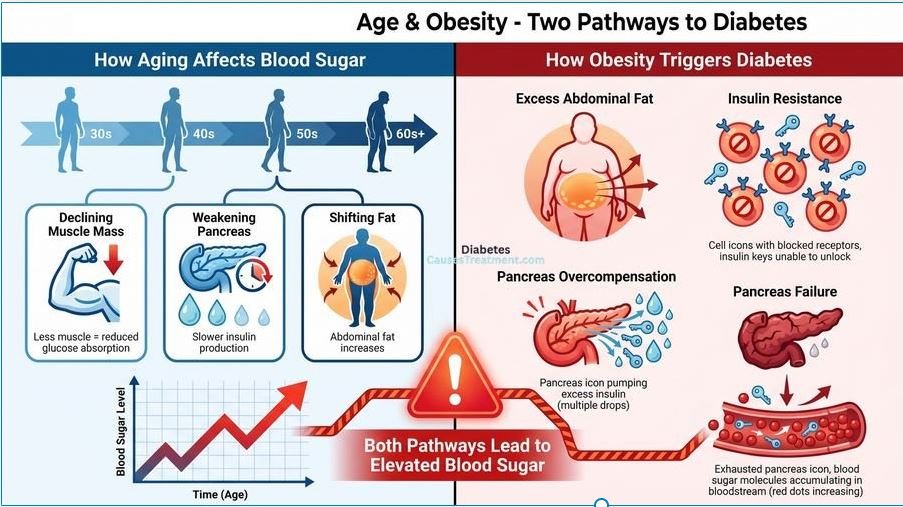
Age can also interact with changes in weight and metabolism. Our guide to how age and obesity affect diabetes risk explains that relationship in more detail.
Physical Activity
Regular physical activity helps your muscles use glucose and can improve insulin sensitivity.
You do not have to become an athlete to benefit. Walking, cycling, swimming, resistance training, and other forms of regular movement can all contribute to better metabolic health.
Diet
Diet affects body weight, blood sugar, and overall metabolic health, but reducing diabetes risk is not about finding one “perfect” food.
A healthier overall eating pattern is more useful than focusing on individual foods in isolation. Choosing more minimally processed foods, vegetables, whole grains, legumes, lean proteins, and other nutrient-dense foods while limiting highly refined carbohydrates and excess calories can support better blood sugar control and weight management.
If you are trying to understand how different carbohydrate-containing foods affect blood sugar, see our guide to the glycemic index for diabetes.
Smoking, Sleep, and Other Health Factors
Diabetes risk is not determined by food and exercise alone. Smoking and certain health conditions can also affect risk.
Sleep may influence insulin sensitivity, appetite, and other metabolic processes as well. Rather than viewing any one behavior as the deciding factor, it is more helpful to think about your overall pattern of health and daily habits.
Genetic Risk vs. Lifestyle Risk: Which Matters More?
There is no universal percentage that tells you how much of your type 2 diabetes risk comes from genetics and how much comes from lifestyle.
That is because the factors interact.
A person with relatively high genetic susceptibility may never develop type 2 diabetes. Another person without a strong family history may develop it because several other risk factors occur together.
A better way to think about the comparison is this:
| Risk Factor | Can You Change It? | What It Tells You |
|---|---|---|
| Genetic susceptibility | No | Some people inherit a greater tendency to develop type 2 diabetes |
| Family history | No | Can reflect both inherited and shared environmental factors |
| Age | No | Type 2 diabetes risk generally increases with age |
| Excess body weight | Often modifiable | Can contribute substantially to insulin resistance and diabetes risk |
| Physical inactivity | Modifiable | Regular activity can improve insulin sensitivity |
| Diet | Modifiable | Eating patterns can influence weight, blood sugar, and metabolic health |
| Prediabetes | Often manageable | Signals that blood sugar is already above the normal range |
The most useful question, therefore, is not whether genetics or lifestyle “wins.”
It is which of your personal risk factors can you do something about?
Can a Healthy Lifestyle Offset Genetic Risk?
Research suggests that it can reduce risk substantially, although healthy habits cannot erase inherited susceptibility.
In a prospective cohort study of more than 19,000 adults, researchers found that healthier lifestyle patterns were associated with lower diabetes risk across different genetic risk categories. Among participants with high genetic risk, intermediate and ideal lifestyle patterns were associated with lower diabetes risk than a poor lifestyle.
That finding reinforces an important point: genetic susceptibility does not make lifestyle irrelevant. If anything, knowing that you have a higher inherited risk gives you more reason to pay attention to the factors you can change.
Large diabetes-prevention studies have also shown that lifestyle interventions can substantially reduce progression to type 2 diabetes among people already at high risk.
The goal is not to “beat your genes.” It is to reduce the modifiable risks that exist alongside them.
How Age and Weight Fit Into the Picture
Age deserves special attention because it is one of the major diabetes risk factors you cannot change.
Type 2 diabetes becomes more common with age. At the same time, aging can be accompanied by changes in body composition, physical activity, muscle mass, and insulin sensitivity.
This does not mean developing diabetes is a normal or inevitable part of getting older.
It means that maintaining physical activity, preserving muscle, managing weight when appropriate, and keeping up with recommended health screenings may become increasingly important as you age.
How Can You Assess Your Own Diabetes Risk?
You do not need genetic testing to begin evaluating your risk.
Start with the risk factors you already know.
Ask yourself:
- Do I have a parent or sibling with type 2 diabetes?
- Am I 45 or older?
- Have I been told that I have overweight or obesity?
- Am I physically active on a regular basis?
- Have I ever had gestational diabetes?
- Have I previously had an elevated blood sugar or A1C result?
- Do I have other health conditions associated with increased diabetes risk?
These questions cannot diagnose diabetes or calculate your exact personal risk. They can help identify whether it is worth discussing screening with your healthcare provider.
If you are unfamiliar with the stage between normal blood sugar and diabetes, read what prediabetes is and what it means for your health.
Should You Wait for Diabetes Symptoms Before Getting Tested?
No.
Prediabetes and early type 2 diabetes can exist without obvious symptoms. That makes symptoms a poor screening tool for someone who already has significant risk factors.
Symptoms such as increased thirst, frequent urination, unexplained weight loss, fatigue, or blurry vision can occur when blood sugar is elevated, but their absence does not necessarily mean your blood sugar is normal.
Our guide to the warning signs of diabetes explains the symptoms that deserve attention.
If you have multiple risk factors, particularly a combination of family history, age, excess weight, previous gestational diabetes, or physical inactivity, ask your healthcare provider whether blood sugar testing is appropriate.
A simple blood test can provide information that symptoms alone cannot.
What Can You Do to Lower Your Lifestyle-Related Risk?
You cannot change your age or the genes you inherited, so concentrate on the factors you can influence.
For many people, that means:
- Becoming more physically active
- Improving overall diet quality
- Losing a modest amount of weight if recommended by a healthcare professional
- Avoiding smoking
- Getting adequate sleep
- Following up on elevated blood sugar results
- Managing other health conditions with your healthcare team
These changes do not need to happen all at once.
If you have prediabetes, structured lifestyle programs have been shown to reduce the likelihood of progressing to type 2 diabetes. Even relatively modest changes in weight and physical activity can have meaningful benefits.
Diet is one important part of that strategy. Our low-glycemic diet guide explains one approach to choosing carbohydrates that have a more gradual effect on blood sugar.
Do You Need Genetic Testing to Understand Your Diabetes Risk?
For most people concerned about common type 2 diabetes, genetic testing is not necessary to identify many of the risk factors that matter most.
Your healthcare provider can evaluate information such as:
- Family history
- Age
- Weight and waist measurements
- Physical activity
- Medical history
- Previous gestational diabetes
- Blood pressure
- Blood glucose and A1C results
Genetic testing and polygenic risk scores are important areas of research, but knowing your genetic score does not replace these established methods of assessing diabetes risk.
If you have an unusual pattern of diabetes in your family, diabetes diagnosed at an unusually young age, or another reason to suspect a less common inherited form of diabetes, your healthcare provider may recommend additional evaluation.
When Should You Talk to Your Doctor About Diabetes Risk?
Consider discussing your diabetes risk with your healthcare provider if you have a family history of type 2 diabetes or other important risk factors.
That conversation becomes especially useful when several risk factors occur together.
Your doctor may recommend a fasting blood glucose test, an A1C test, or another form of blood sugar testing depending on your age, health history, and individual circumstances.
Testing can identify prediabetes or diabetes before noticeable symptoms develop, giving you an opportunity to act earlier.
Final Thoughts
When comparing genetic and lifestyle diabetes risk, the most important lesson is not that one matters and the other does not.
Both matter.
You cannot change the genes you inherited, your family history, or your age. But those factors are only part of your overall risk profile.
Physical activity, diet, weight management, smoking, and other aspects of health can also influence whether type 2 diabetes develops. Research consistently shows that healthier lifestyle patterns can lower risk even among people who are genetically susceptible.
If diabetes runs in your family, treat that knowledge as useful information rather than a prediction.
Know your risk factors. Pay attention to the ones you can change. And when appropriate, talk with your healthcare provider about blood sugar screening rather than waiting for symptoms to appear.
Frequently Asked Questions
Is type 2 diabetes genetic or caused by lifestyle?
Type 2 diabetes is influenced by both. Many genes can contribute to susceptibility, while factors such as excess body weight, physical inactivity, diet, age, and other health conditions also affect risk. For most people, there is no single cause.
If my parents have type 2 diabetes, will I get it?
No. Having a parent with type 2 diabetes increases your risk, but it does not mean you will definitely develop the condition. Other factors, including weight, activity, diet, age, and metabolic health, also contribute.
Can you prevent type 2 diabetes if it runs in your family?
You cannot eliminate inherited susceptibility, but you may be able to lower your overall risk. Regular physical activity, a healthier eating pattern, and modest weight loss when appropriate have been shown to help prevent or delay type 2 diabetes in people at increased risk.
Does having no family history mean my diabetes risk is low?
Not necessarily. People without a family history can still develop type 2 diabetes. Age, excess body weight, physical inactivity, prediabetes, previous gestational diabetes, and other factors can increase risk.
Is prediabetes genetic?
Genetic susceptibility can contribute to prediabetes and type 2 diabetes, but it is only one part of the picture. Prediabetes occurs when blood sugar is above the normal range but not high enough for a diabetes diagnosis, and multiple genetic, metabolic, and lifestyle factors can contribute.
Should I get genetic testing for type 2 diabetes?
Most people do not need genetic testing to evaluate common type 2 diabetes risk. Family history, age, weight, health history, physical activity, and blood sugar testing generally provide more immediately useful information. Your healthcare provider can tell you whether genetic evaluation makes sense in your particular situation.